Showing posts with label Poultry Genetics. Show all posts

Wednesday, January 1, 2014

Unraveling the Blues Old School


Our understanding of how this blue egg gene works is much farther along now but I still loved finding this in the archives of the archives this morning!

 Reginald Punnett (1933). Genetic studies in poultry: IX. The blue egg

Journal of Genetics 27 (3) : 465 - 470

https://web.archive.org/web/20161020042409/www-old.ias.ac.in/jarch/jgenet/27/465.pdf


Friday, December 13, 2013

Gorgeous Colors

We have had an amazingly colorful fall that just seems to go on and on......

The Pirate Egg Projects are on track.  The challenge now is sorting out which pullet is laying which egg and then making decisions as to which birds to carry forward into the 2014 breeding programs.

Chocolate anyone? We've had a bit of confusion over how chocolate genes (both dun and sex-linked!) have infiltrated different project lineages and what to do about it.  I can't say I'm hating the look but I am having to do some test hatching to figure out what the heck we've actually got going on.

I've decided this is actually Zerya's first egg!
Zorie lays long thin blue eggs;
 ZERYA lays the olive eggs.
Zelda's eggs look just like her mother Orchid's;
alas...not shiny but definitely white pores on a pastel mint shell.
The rumpless girls have identical blue eggs.
Love the shine!


These are just some of my favorite pictures from this fall.  There are many more on the pinterest account.


Sunday, September 1, 2013

Colloncas are NOT Tuft-less Araucanas

I've been tinkering with rumpless blue egg layers for the past few year. The first few years were spent working towards fibromelanistic, rumpless, blue egg layers. Finally, last fall year I was able to tease apart my flock into those with muffs and those that are clean faced. I began doing some hardcore cyber sleuthing about South American chickens, blue egg layers, and history. I've come to realize we have an unprecedented amount of knowledge and amazing tools at our disposal to actually use that knowledge.

That's a bit of a long-winded introduction to this summary of what I think I know about the birds in my backyard.

Technically speaking, Araucanas are a hybrid of two unique South American chicken "breeds", the Colloncas and the Quetros. Over time Araucanas have become prevalent enough to be a designated and standardized breed. However, the Colloncas and Quetros never reached enough prominence to be formally recognized beyond perceived indigenous colloquialism. There are distinct differences between these two landraces.

There are many websites detailing the history of the Araucana breed, the differences between what North Americans call "Araucanas" compared to everywhere else in the world, and why Ameraucanas aren't Araucanas and Easter Eggers aren't Ameraucanas. (Woe be to Gertrude Stein who wrote, "A rose is a rose is a rose by any other name.")

The fine-tooth comb of poultry politicians seemed fairly pedantic until I began seeing well educated, experienced Araucana breeders saying that a Collonca is simply a tuftless Araucana. That makes about as much sense as saying Holsteins are Texas Long-horns without horns.

When two animals are crossed, their genetic material is picked apart with roulette wheel precision, and then stuck back together with velcro-like accuracy. Breeders don't get to pick and choose qualities a la carte. Herein lies the true art of animal husbandry. Over time the breeder can manipulate the frequency of various phenotypes and eventually be able to reliably produce more or less perfect specimens.

This is where genetic conservation becomes critical because genes and specific combinations of genes can and do get lost without stewardship. The original stewards of the early Colloncas were lived in remote Andean mountain villages. They required animals that could evade jaguars, monkeys, and condors while thriving on minimal supplemental feed. Special birds may have been kept for purposes other than food supply but they would have been tightly coveted.

It has been a mere handful of years that the indigenous tribes of these areas have even been recognized by their governments. Maintaining pure lineages of their chicken flocks has been a very trivial concern as these people tried to just stay alive.

Additionally, in situ preservation is going to be a tremendous challenge thanks to genetic contributions from the industrialized world. High production birds with their genetic homogeneity have found every nook and cranny of the chicken keeping world.

At this point there are two ideological camps among preservationists. The first emphasizes temperament and behaviors and the second emphasizes stabilizing the phenotype of the birds. It is much easier to create a standard for phenotype than behavior.

I would like to think that my approach will ultimately be a complete failure because these birds are so special that they transcend my pale North American capabilities. Perhaps that's true. More than likely I'll eventually have something that merely approximates the work of South American preservationists.

Every time I sit down at my computer and surf the web I find new initiatives, new information, and new knowledge working it's way to the surface. I'm comfortable tinkering with my flock as I know more and as stronger genetic contributions become available. In the meanwhile, I whole heartedly encourage people to start thinking about their chickens in a broader social context. It will make every egg you collect a bit richer, every feather a bit brighter, and every cluck and crow a deeper in meaning.

Some References You May Enjoy

http://www.aviculture-europe.nl/nummers/09E06A13.pdf

http://gallinachilena.cl

http://www.cetsur.cl/?p=737

http://phys.org/news/2013-08-unscrambling-genetics-chicken-blue-egg.html

Thursday, August 1, 2013

Oona and Starry Night - rumpless, shiny blue egg layers

Oona and Starry Night are half-sisters.  Their momma, Rupa, is nearly rumpless. Their fathers are from a unique flock of birds thought to be composites of birds indigenous to South and Central America and the Pacific Isles. These girls are very small, slow to mature, and a bit more wild than a typical bantam. 
~*~*~*~*~*~
Oona spent last winter as a house pet in our sun room so she got to "help" unwrap presents Christmas morning.  She has dark skin and wild pattern plumage.  Her stint as a house pet has given her a prima donna complex but typically she is exceptionally silent.


Star is a few months older than Oona and she stayed in the Aikiko Project House over the winter. She carries the mottling gene and has the tell tale white dots and white skin.  Her brother, Xeryus, also carries the mottling gene but he has dark skin.  He is equally rumpless.  


It took Oona and Star both almost a full year to start laying.  This is consistent with my experience with the mother, "Rupa" and sister "Cerci".  It is interesting to note that Rupa's eggs are a rather pale, matte blue with a slight green tinge. All of her daughters lay shiny blue eggs without a hint of green.  


These girls are part of the Aikiko Project but the project is paused until fall.  The Aikiko Project is a hatching eggs / genetics learning collaboration. Participants contribute information about their hatches, help puzzle out the genotypes of project birds, and guide project development.  The project group currently functions using facebook, ancestry.com, and photobucket.  A dedicated website is being developed for the fall.   

Saturday, July 13, 2013

Birds of a Feather

See any family resemblance? 
I love this picture! Flame and Jackson are second cousins.  Their great-grandmother is Barbie, my ancient Barred Rock hen.

Barbie x Einstein ---> Rosie x Dora ---> TwoRoo x Rosie ---> Flame

Barbie x Celso ---> Jenny x Rex ---> Lulu x Jack Sparrow ---> Jackson

Jenny and Rosie are half-sisters so TwoRoo and Lulu are cousins.  Go figure! The first generation ended in long E sound; the second generation ended in "ou" sound.  Maybe I should go back to the drawing board on the third generation names....... Flamenco & Spare-O....hmmm, maybe I should think harder....

Friday, July 12, 2013

The Aikiko Project


The Aikiko Project was a counter top hatching eggs, chicken genetics learning collaboration for curious chickenistas (plus, those chicks are just pretty darn cute!).


March 2019 Life is as life goes.....   My Aikikos only live on in the many spin-off flocks people started by buying my hatching eggs, chicks, and birds.   Thank you to all who encouraged and supported the Aikiko Project.  -Alison
__________________________

July 12, 2013  The Aikiko Project is a hatching eggs / genetics learning collaboration. Participants contribute information about their hatches, help puzzle out the genotypes of project birds, and guide project development.  The project group currently functions using facebook, ancestry.com, and photobucket. A dedicated website is being developed for the fall.   


Thursday, June 13, 2013

Young Professor and the Willas


The Blue Wheaten Ameraucana hens (the Willas) are enjoying some time in the Rest & Respite Free Range flock. They seem to be quite happy so I'm going to hold off on segregating them with the purebred Blue Wheaten Ameraucana rooster (Will).


The Rest & Respite Flock protector, "Young Professor", is a purebred (but a non-standard color) Ameraucana with a pleasant temperament and excellent gentlemanly manners. He is much more consistent with the demeanor I need for my flock. Both his father and grandfather were superior flock protectors who the girls would rather follow than hide from.

My best guess-timate is that Young Professor is genetically a blue partridge/brown with multiple melanizing forces. Based on my genetics calculator tinkering I suspect the offspring will appear to be wheaten. The blue genetics mean there could be blue, black, or splash feathering.  (genetic code calculation)


The Rest and Respite Flock, June 2013


Sunday, April 14, 2013

Chocolate and Mauve Rocks


The chocolate gene is so fresh to the United States and that my top priority right now is to simply get the gene introduced into the rock project flocks.  Chocolate is a sex-linked, recessive trait.  (This is NOT the dun gene - that's a totally different beast all together :)

My chocolate gene was derived from an outcross to an English Bantam Chocolate Orpington from Marc Sacre.   At this point the eggs I'm selling are out of a split to chocolate rooster (Rolo) over blue rocks, blue barred rocks, and a black rock.  

Genetic considerations: 1) The chocolate gene is sex-linked and recessive. Only the female offspring have the potential to have a chocolate phenotype. 2) The barring gene is sex-linked and dominant. 3) The blue phenotype is a heterozygous genotype.  Homozygous black and homozygous splash are also possible combinations.

The birds currently in the Project House  include:
* Barred rooster split to Chocolate
* Black Rock pullet
* Blue Rock Project hens & pullets
* Blue Barred Project hens & pullets


Outcomes from Split to Chocolate Rooster x Black Rock pullet


The chocolate gene is a sex-linked recessive trait. Males must need two copies of sex-linked traits in order for the presence of the gene to show. Therefore, some of the males may be carrying a copy of the gene but it does not show. Barring is a sex-linked dominant trait.  Males only need one copy of the gene to appear barred but there will be errant solid feathers.  


Outcomes from Split to Chocolate Rooster x Blue Rock pullet
All of the above plus:


Outcomes from Split to Chocolate Rooster x Blue Barred Rock hens

Both of the above sets of outcomes but the barred roosters will have 2 copies of the barring gene so the barring will be more consistent. 

Thursday, April 4, 2013

Aikikos


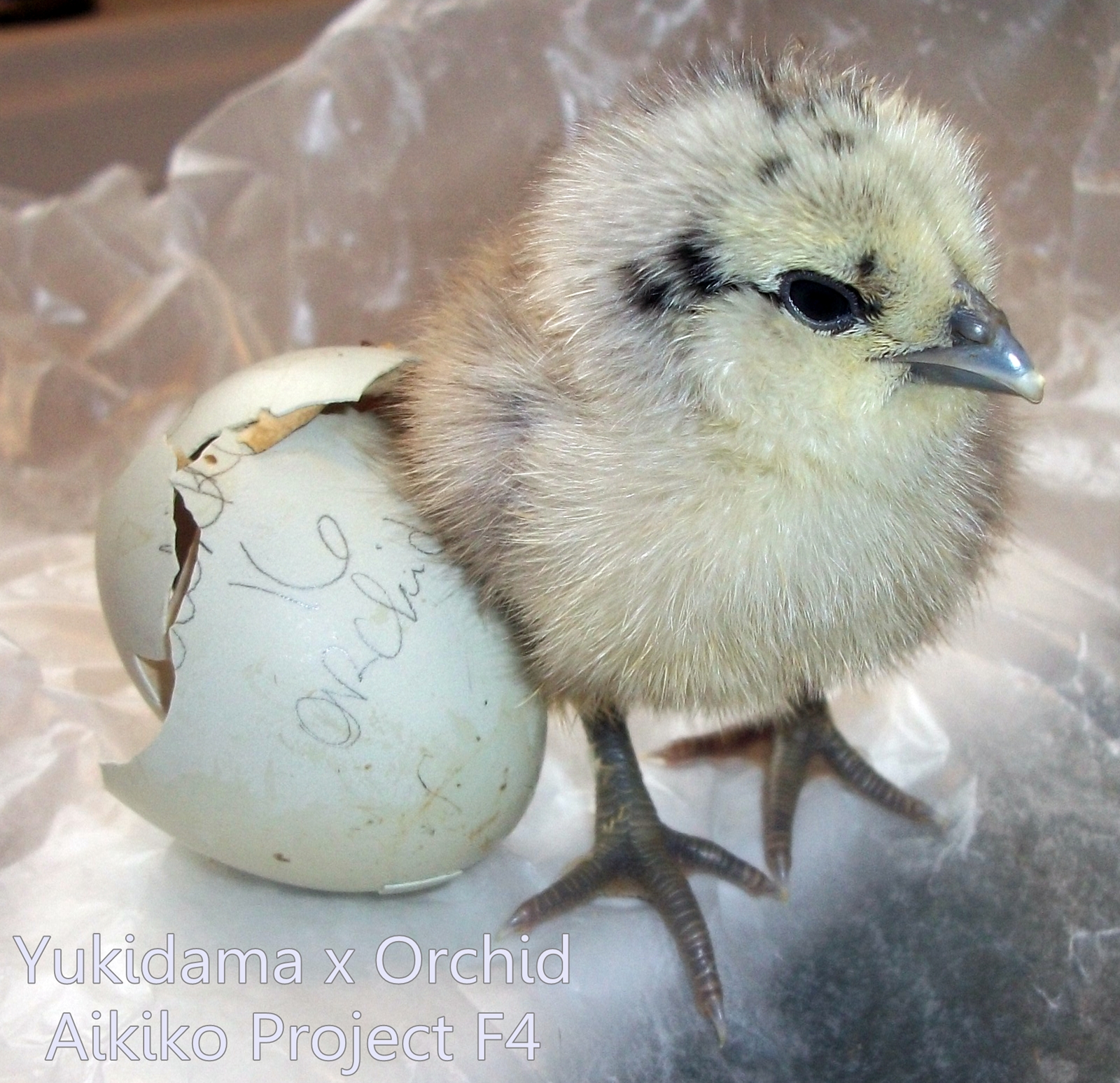
These are BLUE eggs from a line I've been selling and hatching for several years. I'm trying to keep the dark skin and blue eggs while increasing the number of white offspring and (keep your fingers crossed) hopefully carry forward a unique vocalization.  The project is in it's 4th year.

A bit of genetic history...because I just can't help it... The first hen was named Aikiko.  She was just a sweet little wheaten hen from a hatchery mix but she laid these delicate, faintly blue eggs and a nice beard.  

Her daughter "Etsuko" is a product of Aikiko crossed with a black silkie roo (named "Katie").  Etsuko is a black smooth feathered,clean legged hen who lays turquoise eggs. Etsuko's babies tend to have feet like silkies and are occasionally are dark skinned and always bearded.  

Her son "Romeo" is a product of Aikiko crossed with a nearly rumpless wheaten araucana (?) named "Rupert". Romeo was light skinned with a feather pattern similar to silver duckwing.  

Etsuko and Romeo together produced both the roosters I've carried forward into the breeding project this year. There are details about these  Yukidama and Zulema in the description below.  

Currently the Aikiko house has three hens and two roosters: 

Etsuko, Etsuko's grand-daughter "Orchid" (blue salmon daughter of Ocoee x Tuco - a Silkied Ameraucana) and a small gray wheaten easter banty hen named "Opal" are in the breeding area with the Yukidama and Zulema.  

Yukidama is a homozygous recessive white, rumpless, dark skinned, snowball hatched in time for New Year 2012).  He descends from Aikiko x Rupert - a nearly rumpless "true" aruacana.  

Zulema is a black and gold rumpless with very dark skin.  In  addition to being a sweetheart, Zulema makes a very interesting sound when he's trying to impress the ladies.  He goes "wupp wupp wupp". It's different from any others I've ever heard and I'm curious as to how this vocalization carries into future generations.  


White Plumes

UPDATED March 2013


We're now hatching F3 chicks! The F2 birds selected to continue in the breeding program have given us a way to play around with Silver and Gold genes in a Paint project. I'm sad to report my gorgeous orange and white rooster became dinner for a raccoon a few months ago. It's been a bit of a wait for the F2 (TwoRoo) to get interested in the ladies but he's a rowdy boy these days.

Also in the White Plume House is a South American composite rooster (named "Castle" for his amazing comb). Castle has enough genetically in common with the White Plumes that I'm experimenting with a black tailed concept.

One branch of the project is leaning towards WHITE tailed, crested birds. The roosters would have gold or lemon barring; the hens continue to be white & black.

The other branch of the project is leaning towards BLACK tailed, crested birds. The roosters would be cream colored with black lacing; the hens continue to be white & black. 

~*~ This project is named these in honor of White Plume, a chief of the Kaw (Kanza) Indians. In 1825 White Plume's daughters and other members of the tribe were given land along the Kansas (Kaw) River not far from my home. A hundred year later, White Plume's great-great-grandson, Charles Curtis became Vice-President of the United States. White Plume is an ancestor of many present day members of the Kaw Nation in Oklahoma.