Monday, February 9, 2015

Austrian Peas?

Last fall I bought 5 lbs of Austrian Peas intending to grow them as winter fodder for the chickens. I carefully planted them in a somewhat sheltered area on the sunny south side of a coop. After serving several years as the floor of a duck house and a year of being abandoned to the open air, the soil here was fantastic!  However, as is often the case, I drug my heels getting a canopy net up and darned if my South American flock didn't discover and devour all those adorable little seedlings.

Meanwhile, back in the kitchen, I was canning up the paltry 10 pints of green beans we managed to harvest - probably would have only been 6 pints but I stretched them with some sliced carrots. We plowed through those in a mere 2 months. That's partly because they made for a delicious bean soup and partly because my family apparently loves green beans!  We resolved to plan more beans and peas in 2015.

I came across this article (Mother Earth News, Oct/Nov 2014, Cheryl Long) and have been inspired to give these peas a second go around - this time in a glass walled coop that has been fallow for the last six months. I'll have to add a plastic covered canopy but I know for a fact (!) this spot can hold heat.  Now I just need to get my soil heating and perhaps by next week I'll have peas sprouting :)

Thursday, July 31, 2014

Playing with Tommie Toes

I say "playing" because a serious gardener wouldn't buy combo packs of plants simply labeled "Heirlooms".  There was a nice posted list of what they *might* be but it was a wait-and-see-what-you -have grab-bag kind of situation.  It got more complicated the minute I decided to buy singles of several plants and then got the labels mixed up. Perish the thought of saving seeds from this motley mix!
But, of course, I did....We'll see if we can even get them to sprout.

Sunday, July 13, 2014

Wild Blackberry Memories

One of my fondest memories is exploring our land for the very first time way back in July 1997.  We have lovely footage of me working my way through a patch of wild blackberries with our then 10-month old daughter slung on my back.  In the video I'm picking berries and handing them to her over my shoulder.  She's making a valiant attempt to get them into her mouth but every time I get snagged on a thorn, she gets jarred and the berries go flying.   Eventually I notice the berries whizzing past my ears and (in typical oblivious mom fashion) say, "You better hang on to those berries kid 'cause they're kinda like gold."  At that point my amused husband zooms in on our daughter and you see she's got berry mash from ear to ear. 

Saturday, July 12, 2014

Time to Harvest Japanese Beetles

Japanese beetles have moved into my grapevines and begun turning the robust leaves into skeletons.  These little goblins are relatively new to the area and a quick internet search did little to assuage my fears. They will indeed eat the whole plant and move on to the next. (See article Japanese beetles have finally hit KC 7/8/14)

Ever the Polly Positive, I have decided to think of these shiny green beasts creatures as value added extra special chicken treats.  Last night I came up with the following two collection protocols.  

WARNING - BEETLES DIE WHEN YOU FREEZE THEM AND/OR FEED THEM TO YOUR CHICKENS AND/OR DUCKS.  

To Harvest for Later
1. Select a beverage of choice from the refrigerator and drink up - you'll want a narrow neck bottle. 
2. Pick the beetles off of the leaves one or two at a time and place them in the bottle.
3. Place the contents of the bottle in a ziplock bag & put the bag in the freezer for a chicken treat next winter.


To Harvest for Immediate Use
1. Place a bucket of water (or filled baby pool for free ranging animals) next to the affected grapevine.
2. Get your hand wet & begin picking off the beetles and putting them in the bucket of water.  I have gone to all out grabbing whole leaves - completely disrupting their little beetle orgies.
3. Either dump the bucket in a shallow container of water inside your run OR call over your birds to chow down.  


Alternately: scoop the wet & immobilized beetles & stick them in a bag in the freezer. They make cool treats for birds on hot hot summer days.

(PS: My oh-so-sensible husband has pointed out it would be less work to collect them at dawn when they are covered in dew. He doesn't realize how satisfying it is to watch our ducks splash around in their their baby pool looking for beetles!  Also, a narrow neck bottle works infinitely better than a coffee cup ;)  

Wednesday, January 1, 2014

Unraveling the Blues Old School


Our understanding of how this blue egg gene works is much farther along now but I still loved finding this in the archives of the archives this morning!

 Reginald Punnett (1933). Genetic studies in poultry: IX. The blue egg

Journal of Genetics 27 (3) : 465 - 470

https://web.archive.org/web/20161020042409/www-old.ias.ac.in/jarch/jgenet/27/465.pdf


Friday, December 13, 2013

Gorgeous Colors

We have had an amazingly colorful fall that just seems to go on and on......

The Pirate Egg Projects are on track.  The challenge now is sorting out which pullet is laying which egg and then making decisions as to which birds to carry forward into the 2014 breeding programs.

Chocolate anyone? We've had a bit of confusion over how chocolate genes (both dun and sex-linked!) have infiltrated different project lineages and what to do about it.  I can't say I'm hating the look but I am having to do some test hatching to figure out what the heck we've actually got going on.

I've decided this is actually Zerya's first egg!
Zorie lays long thin blue eggs;
 ZERYA lays the olive eggs.
Zelda's eggs look just like her mother Orchid's;
alas...not shiny but definitely white pores on a pastel mint shell.
The rumpless girls have identical blue eggs.
Love the shine!


These are just some of my favorite pictures from this fall.  There are many more on the pinterest account.


Thursday, October 10, 2013

Chicken Breeds Resource

I found this website with short video clips of different breeds of chickens (and ducks, guineas, etc...).  The videos I was looking at appeared to have been taken at a poultry show in Europe so the animals are very nice representatives of the breed.  It was helpful for me because I could see how the animal actually moves - much different than looking at a two-dimensional representation.  Enjoy!

http://www.mypets.egzoticpheasant.com/browse-chickens-videos-1-date.html

Saturday, September 21, 2013

When in Doubt, Change Your Tune

I'm much more successful at finding information South American chickens online when I change my browser language settings from English to Spanish.  (We won't talk about how long that took me to figure out!)

How to Change Your Settings in Google Chrome

Since it took me two years to discover this trick I'm going to break it way down so that when I forget it won't take me another two years to remember. :)

Step 1 Click on the Chrome Settings icon in your browser toolbar


Step 2 Scroll down to the Languages section and click on "Language and input settings"


Step 3 Click on "Add"


 Step 4 Scroll down to "Spanish - Latin America"

Step 5 "Spanish - Latin America" and "Spanish" will get added to your list of languages. You have to drag them to the top for the search engine to prioritize sites written in Spanish.


Step 6 Click "Done" in the lower right corner and close the settings window.  

Tuesday, September 17, 2013

Critter Cam Captures Daily Routines

Well, we didn't get the date or time set right but that motion sensor camera took over a thousand pictures in the span of a week. We had it trained on the central staging area behind the BeakHouse coops. It was fascinating to watch our daily routines unfolding..... we actually forgot it was even there! Unfortunately the predators managed to escape detection. PS It was the last week of June - one of the hottest this year.


Gallinas Urbanas - Urban Homesteaders in Puerto Rico


I found these very cool folks who helping people get started keeping backyard flocks in PUERTO RICO! I'm really enjoying the fact that people are doing the same thing there as we're doing here....simply trying to stay connected with our food supply.  


 Love the logo, love their site :) 


(when you get to their website, right click & you'll have the option to translate the page - it's worth it) 


Gallinas Urbanas


1

Sunday, September 1, 2013

Colloncas are NOT Tuft-less Araucanas

I've been tinkering with rumpless blue egg layers for the past few year. The first few years were spent working towards fibromelanistic, rumpless, blue egg layers. Finally, last fall year I was able to tease apart my flock into those with muffs and those that are clean faced. I began doing some hardcore cyber sleuthing about South American chickens, blue egg layers, and history. I've come to realize we have an unprecedented amount of knowledge and amazing tools at our disposal to actually use that knowledge.

That's a bit of a long-winded introduction to this summary of what I think I know about the birds in my backyard.

Technically speaking, Araucanas are a hybrid of two unique South American chicken "breeds", the Colloncas and the Quetros. Over time Araucanas have become prevalent enough to be a designated and standardized breed. However, the Colloncas and Quetros never reached enough prominence to be formally recognized beyond perceived indigenous colloquialism. There are distinct differences between these two landraces.

There are many websites detailing the history of the Araucana breed, the differences between what North Americans call "Araucanas" compared to everywhere else in the world, and why Ameraucanas aren't Araucanas and Easter Eggers aren't Ameraucanas. (Woe be to Gertrude Stein who wrote, "A rose is a rose is a rose by any other name.")

The fine-tooth comb of poultry politicians seemed fairly pedantic until I began seeing well educated, experienced Araucana breeders saying that a Collonca is simply a tuftless Araucana. That makes about as much sense as saying Holsteins are Texas Long-horns without horns.

When two animals are crossed, their genetic material is picked apart with roulette wheel precision, and then stuck back together with velcro-like accuracy. Breeders don't get to pick and choose qualities a la carte. Herein lies the true art of animal husbandry. Over time the breeder can manipulate the frequency of various phenotypes and eventually be able to reliably produce more or less perfect specimens.

This is where genetic conservation becomes critical because genes and specific combinations of genes can and do get lost without stewardship. The original stewards of the early Colloncas were lived in remote Andean mountain villages. They required animals that could evade jaguars, monkeys, and condors while thriving on minimal supplemental feed. Special birds may have been kept for purposes other than food supply but they would have been tightly coveted.

It has been a mere handful of years that the indigenous tribes of these areas have even been recognized by their governments. Maintaining pure lineages of their chicken flocks has been a very trivial concern as these people tried to just stay alive.

Additionally, in situ preservation is going to be a tremendous challenge thanks to genetic contributions from the industrialized world. High production birds with their genetic homogeneity have found every nook and cranny of the chicken keeping world.

At this point there are two ideological camps among preservationists. The first emphasizes temperament and behaviors and the second emphasizes stabilizing the phenotype of the birds. It is much easier to create a standard for phenotype than behavior.

I would like to think that my approach will ultimately be a complete failure because these birds are so special that they transcend my pale North American capabilities. Perhaps that's true. More than likely I'll eventually have something that merely approximates the work of South American preservationists.

Every time I sit down at my computer and surf the web I find new initiatives, new information, and new knowledge working it's way to the surface. I'm comfortable tinkering with my flock as I know more and as stronger genetic contributions become available. In the meanwhile, I whole heartedly encourage people to start thinking about their chickens in a broader social context. It will make every egg you collect a bit richer, every feather a bit brighter, and every cluck and crow a deeper in meaning.

Some References You May Enjoy

http://www.aviculture-europe.nl/nummers/09E06A13.pdf

http://gallinachilena.cl

http://www.cetsur.cl/?p=737

http://phys.org/news/2013-08-unscrambling-genetics-chicken-blue-egg.html

Thursday, August 1, 2013

Oona and Starry Night - rumpless, shiny blue egg layers

Oona and Starry Night are half-sisters.  Their momma, Rupa, is nearly rumpless. Their fathers are from a unique flock of birds thought to be composites of birds indigenous to South and Central America and the Pacific Isles. These girls are very small, slow to mature, and a bit more wild than a typical bantam. 
~*~*~*~*~*~
Oona spent last winter as a house pet in our sun room so she got to "help" unwrap presents Christmas morning.  She has dark skin and wild pattern plumage.  Her stint as a house pet has given her a prima donna complex but typically she is exceptionally silent.


Star is a few months older than Oona and she stayed in the Aikiko Project House over the winter. She carries the mottling gene and has the tell tale white dots and white skin.  Her brother, Xeryus, also carries the mottling gene but he has dark skin.  He is equally rumpless.  


It took Oona and Star both almost a full year to start laying.  This is consistent with my experience with the mother, "Rupa" and sister "Cerci".  It is interesting to note that Rupa's eggs are a rather pale, matte blue with a slight green tinge. All of her daughters lay shiny blue eggs without a hint of green.  


These girls are part of the Aikiko Project but the project is paused until fall.  The Aikiko Project is a hatching eggs / genetics learning collaboration. Participants contribute information about their hatches, help puzzle out the genotypes of project birds, and guide project development.  The project group currently functions using facebook, ancestry.com, and photobucket.  A dedicated website is being developed for the fall.   

Saturday, July 20, 2013

Happiness Sunny Side Up

Earlier this summer a research review published by the University of Bristol called "The Intelligent Hen Study" summarized years of experiments that quantify what flock owners know, chickens are smart.

The long of the short is chicks can count higher higher, have better self-control, and superior spatial awareness than human toddlers .  They also recognize symmetry...the free form builder in me wonders what they think of the coops I make....

From The Guardian UK June 19, 2013 According to a new report, chickens appear to be much more intelligent than previously thought, with better numeracy and spatial awareness skills than young children. "The domesticated chicken is something of a phenomenon," Christine Nicol, professor of animal welfare at Bristol University, told the Times. "Studies over the past 20 years have revealed their finely honed sensory capacities, their ability to think, draw inferences, apply logic and plan ahead."  

My hamster-speed computer was not able to find the original research online but here's the most detailed article I came across. http://www.news.com.au/lifestyle/parenting/the-intelligent-hen8217-chickens-smarter-than-toddlers/story-fnet08ui-1226666106781

The research review was underwritten by international free-range egg producer Happy Egg Company to help guide facility development.  

I'm very curious about what Happy Egg will do with the information and how their facilities will address flock enrichment.  While this may seem odd, awkward, and impractical in the eyes of the battery cage industry, I'm sure follow up research will happen over the next few years.  Sparky's Related Article on Friendships in Commercial Flocks

 Happy Hens Company's Natural Hen Habitat   (Out of detest for common industry practices I have resisted the urge to point out all the reasons why a nicely manicured park-like setting with a flock of genetically identical birds really doesn't look very natural. However, you should visit their website, it's actually quite interesting!)
----------------------------------------------------------------------------------------

And, BTW -  In 2011 Vegetarians International Voice for Animals (VIVA!) called out Happy Egg Company, salaciously documenting something else flock owners already knew -  chickens poop...and they die...and when they're little they need more supervision, and when they're older they need to leave the work force.  I wasn't shocked by VIVA's findings; I was terrified by how little people know about the reality of the food they eat. Photoshop may be able to hide those bare spots scratched into the carefully mowed pasture by Happy birds looking for tasty treats, but all the digital manipulations in the world won't take away the fact that people actually expect those to be completely real.

Saturday, July 13, 2013

Birds of a Feather

See any family resemblance? 
I love this picture! Flame and Jackson are second cousins.  Their great-grandmother is Barbie, my ancient Barred Rock hen.

Barbie x Einstein ---> Rosie x Dora ---> TwoRoo x Rosie ---> Flame

Barbie x Celso ---> Jenny x Rex ---> Lulu x Jack Sparrow ---> Jackson

Jenny and Rosie are half-sisters so TwoRoo and Lulu are cousins.  Go figure! The first generation ended in long E sound; the second generation ended in "ou" sound.  Maybe I should go back to the drawing board on the third generation names....... Flamenco & Spare-O....hmmm, maybe I should think harder....

Friday, July 12, 2013

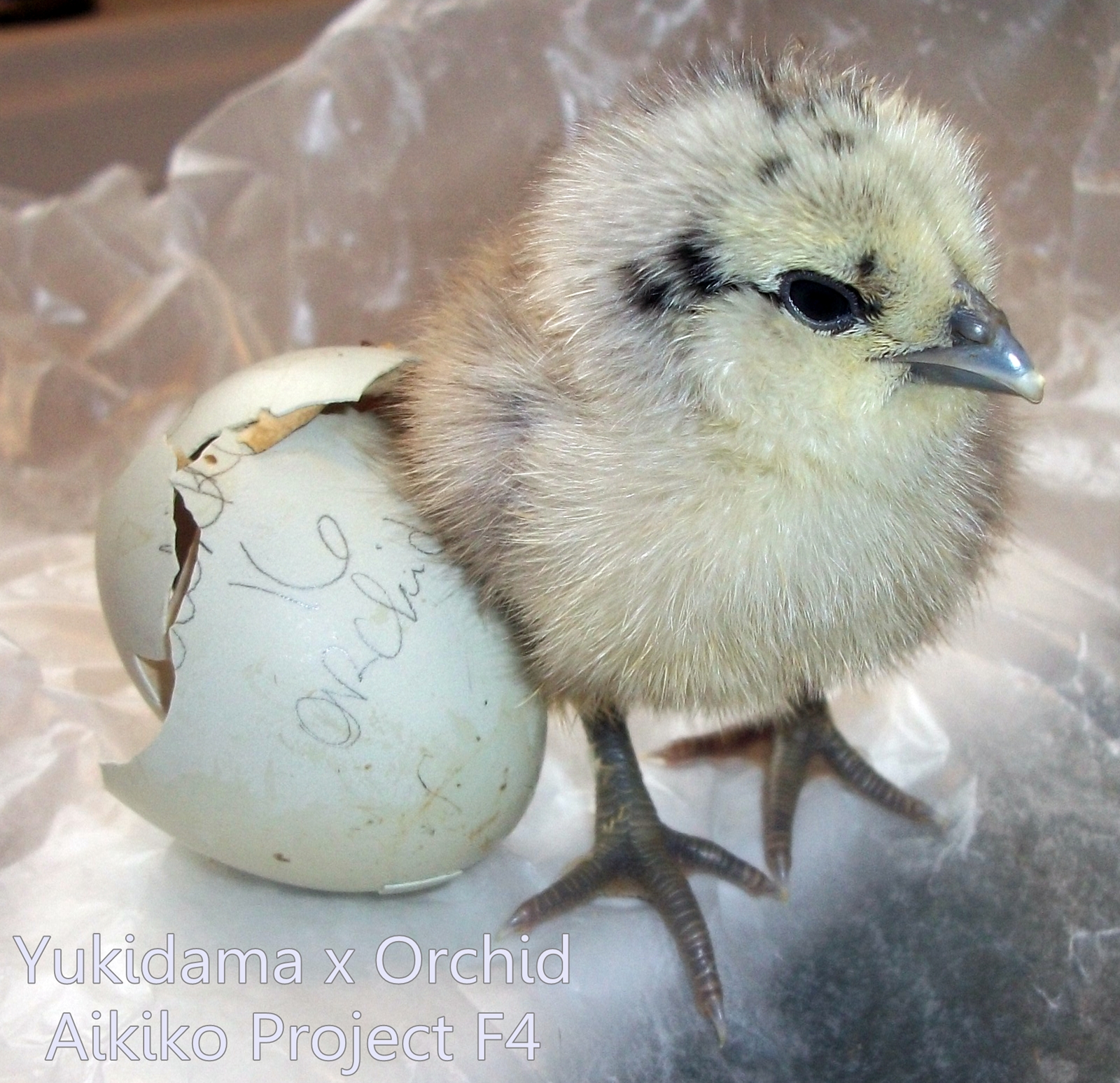
The Aikiko Project


The Aikiko Project was a counter top hatching eggs, chicken genetics learning collaboration for curious chickenistas (plus, those chicks are just pretty darn cute!).


March 2019 Life is as life goes.....   My Aikikos only live on in the many spin-off flocks people started by buying my hatching eggs, chicks, and birds.   Thank you to all who encouraged and supported the Aikiko Project.  -Alison
__________________________

July 12, 2013  The Aikiko Project is a hatching eggs / genetics learning collaboration. Participants contribute information about their hatches, help puzzle out the genotypes of project birds, and guide project development.  The project group currently functions using facebook, ancestry.com, and photobucket. A dedicated website is being developed for the fall.